
Celebrating Two Years of Rail Service
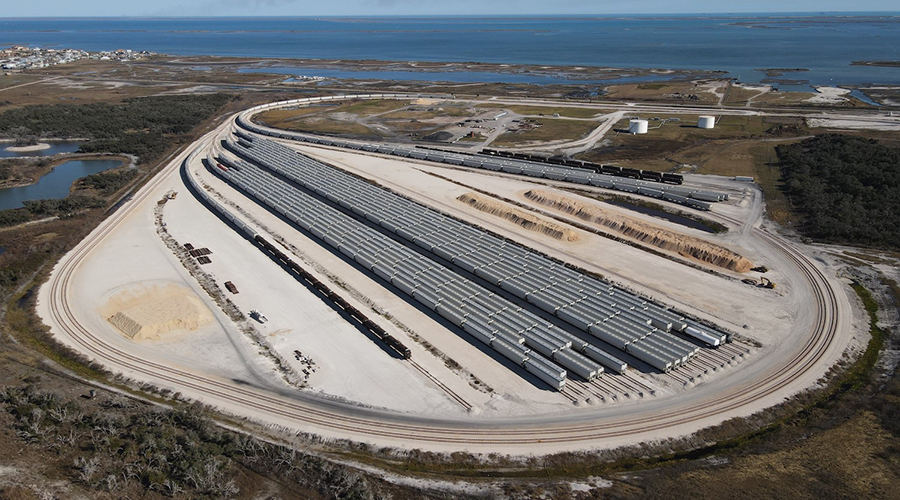
Share Post : Celebrating Two Years of Rail Service At CNR, we have long been committed to developing state-of-the-art infrastructure to support the efficient transportation of goods across North America. Our partnership with Jones Capital has culminated in the expansion of Rockport Terminals, a 250-acre premier private multi-modal facility located strategically along the Texas Gulf Coast. This terminal, offering a seamless connection between rail, water, and highway, is poised to revolutionize the logistics industry by providing unparalleled access and flexibility to industries moving goods through this region. With its advantageous location, the Rockport Terminals serves as a critical transportation hub, bringing substantial value to industries reliant on efficient transportation of commodities. The terminal supports a wide range of cargo, including bulk liquids, dry commodities, petrochemicals, and industrial goods, positioning it as an essential asset in the supply chain network. Key Features of Rockport Terminals 1. Multi-Modal Access for Optimal Flexibility Rockport Terminals is equipped with direct access to water, rail, and highways, enabling a robust transportation ecosystem. The terminal’s multi-modal connectivity ensures that businesses can streamline their operations by leveraging a combination of transportation modes to achieve cost-effective and efficient logistics solutions. Rail Access: Our partnership with Union Pacific Railroad has been a cornerstone of the terminal’s growth, providing dedicated rail access that extends connectivity across the entire U.S. rail network. This ensures rapid and reliable transport of goods to and from key markets across North America. Waterway Access: Situated along the Texas Gulf Coast, Rockport Terminals has easy access to maritime shipping routes, including the Gulf Intracoastal Waterway. This allows businesses to capitalize on water transport for large volumes of bulk commodities, reducing congestion on land-based networks. Highway Infrastructure: Proximity to major Texas highways adds yet another layer of accessibility, facilitating the smooth movement of goods by road, especially for time-sensitive shipments. 2. Advanced Rail Service: Two Years of Success with Union Pacific In collaboration with Union Pacific Railroad, Rockport Terminals recently celebrated two years of continuous rail service near Corpus Christi, Texas. This partnership has dramatically increased the terminal’s rail capacity and efficiency, providing crucial transportation links for a broad spectrum of commodities. The Union Pacific connection has allowed us to handle a growing number of railcars, contributing to the terminal’s increasing role in the regional and national logistics landscape. Our rail infrastructure supports the transportation of liquid bulk products, dry bulk materials, and various industrial commodities, with expansion capabilities to accommodate increasing demand. 3. Strategic Location on the Texas Gulf Coast Located near Corpus Christi, Texas, the Rockport Terminals is uniquely positioned to serve a variety of industries, from petrochemicals to agriculture. The terminal’s proximity to key industrial hubs ensures that goods can be moved efficiently to and from the region’s largest processing plants, refineries, and industrial complexes. Moreover, the Texas Gulf Coast serves as a critical gateway for international trade, particularly with Latin America and Europe. The terminal’s strategic position allows businesses to benefit from quicker transit times to international markets while also serving domestic destinations. 4. Environmentally Conscious and Sustainable Development CNR and our partners have designed the Rockport Terminals with sustainability in mind. By prioritizing multi-modal transport, we are reducing the environmental impact of logistics by decreasing reliance on road transport, which is associated with higher carbon emissions. Rail and water transport provide more energy-efficient options, enabling businesses to lower their carbon footprint while still moving significant quantities of goods. Additionally, the terminal is committed to implementing environmentally responsible practices, including pollution controls, energy-efficient operations, and long-term sustainability initiatives. Expansion Plans and Future Outlook As we look ahead, CNR remains focused on expanding the capabilities of Rockport Terminals to meet growing demand. Plans are in place to further enhance rail capacity, expand warehousing and storage facilities, and deepen partnerships with other key transportation providers. With the Gulf Coast region projected to experience significant growth in industrial output, the Rockport Terminals is well-positioned to support this expansion by offering world-class logistics infrastructure. We are committed to continuous improvement, ensuring that the terminal remains a vital hub for North American and international trade. Growth Projections and Economic Impact The continued development of Rockport Terminals will bring substantial economic benefits to the region. Increased trade volumes, job creation, and improved access to national and international markets are all anticipated outcomes. The facility’s expansion is expected to attract more industries and businesses looking to take advantage of its comprehensive transportation solutions. Conclusion: A Gateway for Global Trade CNR, in partnership with Jones Capital, has established Rockport Terminals as a pivotal player in North American logistics. The terminal’s integration of rail, water, and highway access—coupled with its strategic location on the Texas Gulf Coast—makes it a key gateway for industries across the continent. As we continue to expand and enhance our services, Rockport Terminals will remain at the forefront of innovation in the transportation sector, driving growth and supporting global trade. September 14, 2024 Celebrating Two Years of Rail Service
Rockport Terminals Surpasses 100,000 Tons Handled
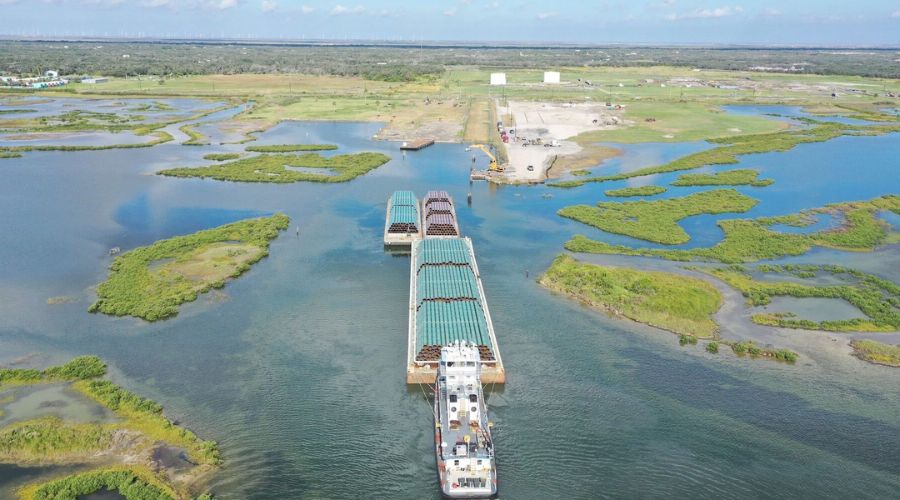
Share Post : Rockport Terminals Surpasses 100,000 Tons Handled Just four years ago, the site of the old Degussa Evonik carbon black plant in Rockport, Texas, was sitting idle, inactive for close to eight years. The 250-acre site, which first opened as a carbon black plant in 1941, ceased operations at the end of 2008. In 2016, though, when business partners Ed Nelson and Clayton Reaser surveyed the site, they saw nothing but potential. “We saw this property, and it was a large landholding with rail, great highway access and 64 acres right on the Intracoastal Waterway with a port facility, pipelines and tanks,” Nelson said. With a vision and plenty of determination, Nelson and Reaser purchased the property in 2016 and formed Rockport Terminals LLC. Their grit would soon be tested when Hurricane Harvey dealt the property a direct hit in 2017. Despite damage from the hurricane, the environmental remediation of the property marched on, taking nearly three years to complete. In all, more than 60,000 tons of affected soil was removed and remediated in the cleanup process. “We cleaned it to a very high standard,” Nelson said. “We partnered with two environmental companies. The Texas Commission on Environmental Quality has given us the all-clear for all past and future environmental liability, and it’s cleaned to the highest standard. “We’re very proud of that,” he added. “It basically opens the door for us to do the highest and best use for the property.” About a year ago, Nelson said, repairs were made to the tanks, pipeline and dock that were damaged during Hurricane Harvey. Last year, they also received all the necessary permits from the U.S. Coast Guard and Texas authorities to reopen the site as a port and terminal facility. “Then, in October of last year, we had two tenants move in,” Nelson said. “One is using the terminal for bulk diesel, and the other is using it for breakbulk delivery and distribution of pipeline. All these products are brought in by barge, and there’s enough room in our facility for 12 barges.” Nelson said the terminal’s slip has been dredged to accommodate barges requiring a 10-foot draft. On site, Rockport Terminals has capacity to store 45,000 barrels of liquid cargoes (growable to 1 million barrels). The facility offers a transfer rate between the dock and tanks of 3,500 barrels per hour. There are also 50 acres available for cargo lay-down or bulk goods processing. And with both highway and rail access alongside connection to the Gulf Intracoastal Waterway, the terminal supports multimodal cargo transfers. Thus far, about 110,000 tons of cargo have come into Rockport Terminals by barge. “Now, our next and final spoke is upgrading and finishing our rail,” Nelson said. “That will give us access to the Mexican market with petroleum, and we’ll be able to deliver pipe to the rest of Texas by rail. We can also bring in aggregate by barge and distribute it throughout Texas by rail. The aggregate can come in from as far away as Pennsylvania.” Nelson specifically mentioned three large-scale projects nearby as hopefully feeding cargoes into Rockport Terminals: Steel Dynamics’ new steel mill in nearby Sinton, Texas; the forthcoming ethane steam cracker ExxonMobil and SABIC are building near Corpus Christi; and the Port of Corpus Christi itself. “There’s so much infrastructure that’s being built here,” he said. “Massive tank farms. There are now five pipelines coming here from the Eagle Ford and Permian basins in Texas. As one operator said, there’s a tsunami of crude oil coming to Texas.” Rockport Terminals’ chief financial officer, Matthew White, said the space should be attractive for both new and existing companies in the area. “Rockport Terminals created a much-needed base for companies that were already operating in the Corpus area but were having trouble finding dock and terminal space to conduct business and grow,” White said. “The site will benefit both the operators and the local community of Aransas County.” Nelson said it’s a rare thing to find a site with such wide-ranging development potential. “We’re the only new, private port in the area,” he said. “And it’s especially rare to find one that has rail, water and highway access with no residential development around it. We’re basically a blank canvas, ready to go.” For more information on Rockport Terminals please contact us by clicking here. Article Courtesy of Waterways Journal September 12, 2024 Celebrating Two Years of Rail Service April 18, 2020 Rockport Terminals Surpasses 100,000 Tons Handled